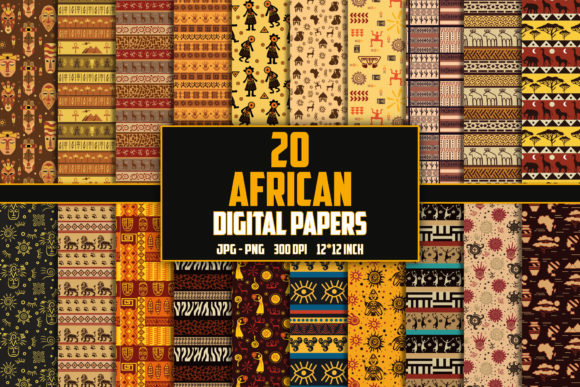
African Digital Paper JPG and PNG
If you're designing invitations for a vibrant African-themed wedding, printing bold Ankara-inspired fabric for a boutique clothing line, or assembling a meaningful scrapbook that honors heritage and storytelling — African Digital Paper JPG and PNG is the kind of resource that quietly transforms your workflow. These aren’t generic patterns pulled from a stock library. They’re thoughtfully crafted digital papers rooted in authentic African textile motifs — from Adinkra symbols and Kente geometry to contemporary interpretations of Mudcloth, Shweshwe, and Zulu beadwork — all delivered at print-ready quality.
Where These Files Shine in Real Life
Imagine this: You’re a small-batch fashion designer launching a spring collection inspired by West African textiles. You need seamless, scalable patterns for cotton voile scarves and linen jumpsuits — but hiring an illustrator for custom repeats isn’t in your budget. With African Digital Paper JPG and PNG, you get 20 ready-to-use, high-resolution repeats that tile flawlessly across any garment layout software. No awkward seams, no pixelation when scaled up for yardage prints — just crisp, confident color and rhythm.
Or picture a mom crafting birthday invitations for her daughter’s “Journey Through Africa” party. She wants rich, warm tones and culturally grounded visuals — not clipart lions or cartoon baobabs. Using these files in Canva or Adobe Express, she overlays elegant script fonts onto a deep indigo wax-print background, then exports straight to her local print shop. The result? Invitations that feel intentional, respectful, and full of quiet pride — all made in under an hour.
Scrapbookers also find unexpected depth here. Rather than relying on pre-cut paper pads with limited themes, they use the 3600×3600 pixel files as layered backgrounds, photo mats, or subtle texture overlays. A faded sepia portrait of a grandparent looks especially tender against a soft, tonal Ndebele-inspired pattern — adding cultural resonance without overwhelming the memory.
What You Actually Get (and Why It Matters)
You receive 20 seamless digital papers, each available in both JPG and PNG formats — giving you flexibility depending on your project. Need transparency for layering over photos or text? PNG delivers that cleanly. Prepping for CMYK commercial printing? JPG works reliably with most professional printers.
Every file is sized at 12″ × 12″ / 3600 × 3600 pixels and rendered at 300 DPI. That means whether you’re printing a 5×7 invitation or a 24×36 gallery wrap, the detail holds. You’ll see the fine grain of hand-stamped Adinkra motifs, the subtle variation in dyed threads of a simulated Bogolanfini repeat, and the clean edges of geometric Kente borders — no blurring, no softening, no guessing.
The full bundle clocks in at 67.9 MB — large enough to preserve fidelity, small enough to download quickly on most home connections. And because the files are pre-organized and named intuitively (e.g., “Adinkra_Gold_Repeat.jpg”, “Mudcloth_Terracotta_PNG.png”), you spend less time hunting and more time creating.
Who Benefits — and How
- Independent stationery designers use these papers to build cohesive invitation suites — matching envelope liners, RSVP cards, and thank-you notes — without commissioning original art for every element.
- Etsy sellers and print-on-demand creators drop these into mockup templates for mugs, tote bags, and phone cases. The seamless nature means no visible tiling on curved surfaces or wraparound designs.
- Teachers and community educators incorporate them into classroom posters, lesson handouts, or student-led heritage projects — offering visual literacy alongside cultural context.
- Wedding planners and DIY couples lean on them for consistent branding across save-the-dates, ceremony programs, menu cards, and even digital Zoom backdrops — all unified by one authentic visual language.
Things to Keep in Mind Before You Start
While African Digital Paper JPG and PNG delivers exceptional quality, it helps to know how it fits into your creative ecosystem. First: these are digital papers, not vector illustrations. If you need to infinitely scale a single symbol (like isolating one Adinkra glyph and enlarging it to mural size), you’ll want vector assets instead. But for surface design — fabric, paper, packaging — raster at 300 DPI is the industry standard and performs beautifully.
Second: licensing is for personal and commercial use, but always check the included license terms for specifics around resale restrictions (e.g., you can sell printed notebooks using these papers, but not resell the files themselves as a new digital product).
Third: color accuracy matters. Your screen may render deep ochres or burnt siennas differently than your printer does. For critical color matching — especially in apparel or branding — order a physical proof first. The high-fidelity files give you the best possible starting point; ambient light, monitor calibration, and ink profiles still play supporting roles.
Why “High Quality” Isn’t Just Marketing Speak
That “300 DPI at 3600×3600” spec isn’t arbitrary. It’s the exact resolution used by professional print houses for premium brochures, greeting cards, and fabric swatches. It means when you zoom in, you don’t see jagged edges or muddy gradients — just clean transitions and intentional texture. You’ll notice how the simulated hand-dye variations in a Shweshwe-style repeat stay nuanced, not noisy. Or how the spacing between repeating Nsibidi symbols remains mathematically precise, supporting both aesthetic harmony and cultural integrity.
This level of care makes the difference between something that *looks* African-inspired and something that *feels* respectfully grounded — where pattern isn’t just decoration, but dialogue.
More Than Backgrounds — A Creative Anchor
These files often become the quiet foundation of bigger ideas. A graphic designer uses one as the base for a nonprofit’s annual report on girls’ education in Ghana — letting the pattern echo resilience and tradition without words. A quilter imports the PNG into her embroidery software to guide stitch placement on a commemorative wall hanging. A poet layers a translucent version behind spoken-word performance slides, letting rhythm and repetition visually echo the cadence of her lines.
That’s the unspoken strength of African Digital Paper JPG and PNG: it doesn’t shout. It supports. It elevates. And because it arrives polished, predictable, and production-ready, it gives you space — not just pixels — to bring your own voice forward.