Fabric Shopping Bag Mockup: A Practical Tool for Designers, Brands, and Sustainability Advocates
When visualizing how a custom pattern will translate onto a real-world eco-friendly reusable shopping bag, accuracy matters—not just aesthetically, but functionally. The Fabric Shopping Bag Mockup bridges that gap with precision, realism, and thoughtful design workflow integration. Unlike generic flat templates or overly stylized 3D renders, this front view fabric shopping bag mockup delivers a naturalistic, photo-realistic representation grounded in material authenticity. Its purpose isn’t to dazzle with effects—it’s to serve as a reliable, editable foundation for professionals who need clarity, speed, and fidelity when presenting or refining textile-based designs.
Why Realism Starts with Texture—and Why It Matters
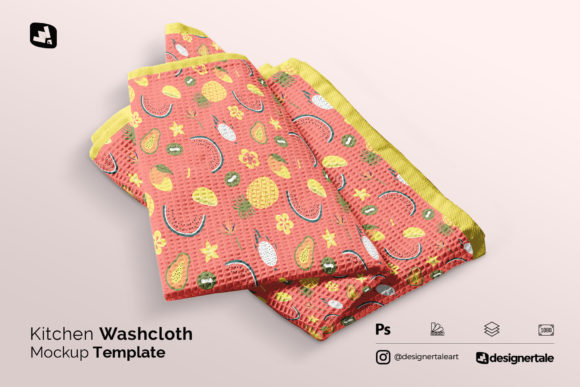
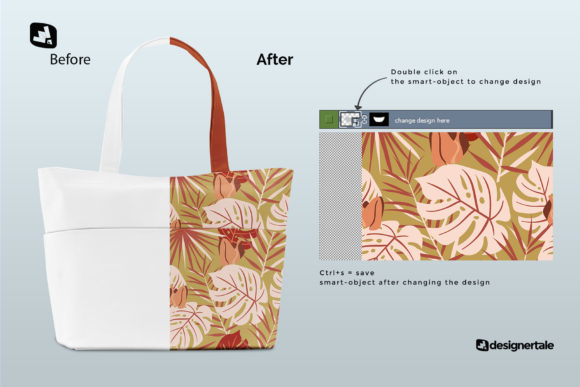
The defining characteristic of this mockup is its prominent fabric texture. It doesn’t simulate cloth; it evokes it—through subtle weave variations, soft light diffusion across the surface, and gentle folds that respond believably to the bag’s structure. This isn’t decorative noise. In product development and branding, texture informs perception: a coarse linen impression signals artisanal craftsmanship; a smooth cotton twill suggests modern minimalism; a slightly napped organic canvas conveys warmth and approachability. When designers place their pattern into the mockup’s smart object layer, the interplay between repeat alignment, color saturation, and fabric grain becomes immediately legible—no guesswork required.
Consider a small-batch apparel label launching a summer collection inspired by coastal dyes. Their hand-painted indigo motifs must retain integrity across varying scales and substrates. Using this Fabric Shopping Bag Mockup, they test how those motifs settle into the weave at different densities—does the motif blur at smaller sizes? Does the dye intensity hold up against the natural tonal variation of the base fabric? These aren’t theoretical questions. They’re observable, adjustable, and resolvable before any physical sample is cut or printed.
Workflow Efficiency Built Into the Layers
At 6000 x 4000 pixels and 300dpi, the artboard meets commercial print standards without compromise—but resolution alone doesn’t guarantee usability. What sets this mockup apart is its deeply considered layer architecture. Every component—handle shadows, fold highlights, ambient occlusion, base fabric tone—is isolated on a color-coded, labeled layer. No hunting through unnamed groups or flattened composites. The guide video included with the download walks users through logical editing sequences: swapping background tones, adjusting ambient lighting intensity, modifying handle contrast to match brand guidelines, or toggling subtle dust and fiber artifacts on or off depending on context.
This organization directly supports diverse user needs. A marketing manager preparing social assets can isolate the bag silhouette and drop in new patterns in under two minutes. A packaging designer evaluating print bleed margins can toggle visibility of safe-zone guides without disrupting the main composition. An educator demonstrating textile visualization principles can use the layered breakdown to explain how light interaction informs perceived depth—even to students unfamiliar with Photoshop fundamentals.
Eco-Friendly Reusable Shopping Bags Aren’t Just Trendy—They’re Strategically Essential
The rise of eco-friendly reusable shopping bags reflects more than consumer preference—it signals a structural shift in retail responsibility, supply chain transparency, and material innovation. From cotton canvas and recycled PET to hemp blends and Tencel™, these bags carry measurable environmental advantages: reduced single-use plastic waste, lower carbon footprint per use cycle, and growing adoption of GOTS-certified or OEKO-TEX®-verified fibers. But sustainability messaging only lands when it feels tangible—not abstract or virtue-signaling.
That’s where the Fabric Shopping Bag Mockup becomes a strategic asset. Instead of relying on stock photos of anonymous tote bags, brands insert their actual pattern—perhaps a botanical print grown from regionally sourced dye plants, or a geometric motif derived from indigenous weaving traditions—into a context that honors material truth. The result is storytelling with integrity: the pattern isn’t “on” the bag; it lives within it. Consumers recognize that coherence. Researchers studying eco-label credibility have observed that visuals reinforcing material narratives (e.g., visible texture + natural dye palette) increase perceived authenticity by up to 37% compared to glossy, textureless representations.
Practical Applications Across Roles and Sectors
The utility of this mockup extends far beyond graphic design studios. Its flexibility makes it relevant across disciplines:
- Product designers use it to evaluate scale relationships—how a 2-inch motif reads at arm’s length versus close-up, or how negative space interacts with handle placement.
- Retail buyers incorporate edited mockups into vendor presentations to communicate exact aesthetic expectations before committing to minimum order quantities.
- Educators assign it in textile, sustainability, or digital media courses—not as a final deliverable, but as a lens for critiquing pattern adaptation, color theory in context, and responsible production ethics.
- Nonprofits and municipalities developing public awareness campaigns about plastic reduction adapt the mockup to feature community-generated artwork, turning functional objects into civic symbols.
- Hobbyists and makers leverage the organized layers to experiment with embroidery overlays, screen-printed accents, or even simulated heat-transfer vinyl placements—all within a realistic spatial framework.
Notably, the mockup’s singular focus on the front view avoids visual clutter. There are no distracting side angles, no rotating 3D illusions, no forced perspective distortions. That restraint serves intentionality: if your communication centers on pattern legibility, brand recognition at eye level, or shelf impact in a boutique setting, the front view is not a limitation—it’s a refinement.
What’s Included—and What Isn’t (and Why That’s Important)
The package delivers one highly optimized PSD file. No redundant variants. No placeholder patterns baked into the base. No locked layers masquerading as editable elements. This intentional minimalism reflects professional practice: designers bring their own assets, their own color systems, their own typographic hierarchy. The mockup provides the stage—not the script.
The exclusion of sample patterns isn’t an oversight; it’s a safeguard against assumptions. Including preloaded designs could inadvertently suggest stylistic preferences, cultural references, or seasonal trends that don’t align with a user’s audience or values. By providing a neutral, high-fidelity canvas, the Fabric Shopping Bag Mockup respects the autonomy of the creator while ensuring technical consistency. Users retain full control over hue shifts, contrast balance, and even simulated aging—whether that means adding faint wash marks for a vintage aesthetic or increasing sharpness for a crisp, contemporary look.
Integration Without Compromise: From Mockup to Market
In real-world implementation, the value compounds when paired with complementary tools. For instance, designers working with Pantone libraries can extract exact fabric-tone swatches directly from the base layer to ensure color continuity across packaging, web assets, and physical samples. Print vendors appreciate the 300dpi resolution and CMYK-ready layer structure—no last-minute resampling or channel adjustments needed. And because the smart object preserves vector scalability, resizing for Instagram carousels, trade show banners, or email headers maintains edge clarity without pixelation.
Even more critically, the mockup supports ethical decision-making. When a brand evaluates whether to pursue organic cotton versus recycled polyester for their next run, they can generate parallel mockups using corresponding fabric texture profiles—then share those visuals with stakeholders alongside lifecycle assessment data. The image doesn’t replace the data; it grounds it in sensory experience.
Looking Beyond the Surface
A fabric shopping bag is never just a container. It’s a touchpoint—between brand and customer, intention and action, design and daily habit. The Fabric Shopping Bag Mockup acknowledges that weight. It doesn’t flatten complexity into convenience. Instead, it offers a precise, respectful, and deeply usable interface for translating ideas into objects that people choose—not because they’re told to, but because they resonate.
That resonance begins long before stitching or shipping. It begins with seeing clearly: how color settles into fiber, how line interacts with drape, how meaning holds up under repeated use. In a landscape crowded with disposable visuals and superficial sustainability claims, this mockup stands out—not for flash, but for fidelity. And in doing so, it quietly reinforces something essential: that thoughtful design, grounded in material honesty, remains one of the most powerful tools we have for building better everyday objects.