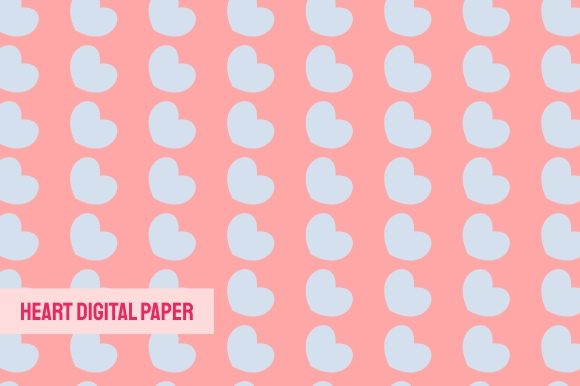
Heart Digital Paper: Seamless Creative Freedom
If you’ve ever spent hours adjusting tile alignment on fabric mockups, struggled to scale a pattern without pixelation for large-format printing, or delayed a client presentation because your background lacked visual cohesion—Heart Digital Paper solves that quietly. It’s not another generic texture pack or overused clipart set. It’s a high-fidelity, mathematically seamless heart motif designed from the ground up for real-world creative workflows—where precision, flexibility, and speed matter more than decorative flair alone.
What Makes This Pattern Actually Seamless—And Why That Changes Everything
“Seamless” is often misused. Many patterns claim it but break at edges when tiled—visible repeats, misaligned stems, or awkward gaps that force manual editing. Heart Digital Paper avoids this by using true algorithmic tiling logic: every edge matches its opposite down to the sub-pixel level. The result? You can fill a 10-foot-wide trade show backdrop or a 24-inch square gift box wrap with zero visible joins—no layer masks, no clone-stamping, no trial-and-error resizing.
This isn’t just convenience—it’s fidelity. When you’re designing custom apparel for a boutique launch, inconsistent tiling shows up as warped motifs across seams or hems. For educators creating printable classroom posters, jagged repeats distract from learning content. Heart Digital Paper eliminates those compromises before they start.
Practical Uses That Go Beyond “Pretty Backgrounds”
Because it arrives as a 3600×3600 px JPG—high-res but universally compatible—you don’t need Photoshop expertise or subscription software to use it. Open it in Canva, Affinity Designer, Silhouette Studio, or even Microsoft PowerPoint, and it scales cleanly up to A0 poster size or down to a 2-inch label without interpolation blur.
- Fabrics & textiles: Import directly into Spoonflower or Printful’s uploader; the resolution meets their minimum requirements for sharp dye-sublimation prints on scarves, tote bags, or upholstery samples.
- Gift wrapping & stationery: Tile across 8.5×11″ PDFs for printable kraft paper sheets—or crop sections for custom thank-you card borders that align perfectly across fold lines.
- Wallpaper & backdrops: Use it as a subtle tone-on-tone overlay behind text in Keynote or Google Slides, or scale it full-bleed for virtual meeting backgrounds that look intentional, not generic.
- Educational materials: Teachers print it as a non-distracting writing prompt background—soft enough to support focus, structured enough to reinforce thematic warmth (e.g., empathy units, health curricula).
Who Benefits Most—and How They Use It Differently
Freelance surface designers use Heart Digital Paper as a foundational layer—not as a final product, but as a reliable base for adding hand-drawn flourishes or color variations. Because the repeat is neutral yet expressive, it holds up under overlays without competing visually.
Small business owners launching seasonal packaging often face tight deadlines and limited design resources. One user—a candle maker—replaced three separate vendor-designed labels with a single Heart Digital Paper file: she tiled it across jar sleeves, used cropped sections for sticker seals, and applied a light duotone filter for her Instagram story highlights—all in under 90 minutes.
Bloggers and course creators appreciate how it bridges digital and physical branding. Instead of switching between mismatched Canva templates and printed swag, they maintain consistency: the same heart rhythm appears on their eBook cover, Zoom background, and downloadable workbook pages—creating subconscious recognition without rigid logo repetition.
No-Compromise Resolution—But Know Its Boundaries
The 3600×3600 px resolution strikes a deliberate balance: large enough for crisp 300 DPI output at ~12×12 inches (ideal for most print-on-demand services and desktop printers), yet small enough to open instantly in lightweight apps. It’s not meant for billboard-scale vector reproduction—but few users actually need that. If your project requires infinite scalability (e.g., architectural wall murals with intricate zoom-ins), a vector version would be better suited. Heart Digital Paper excels where JPG reliability matters most: consistent color rendering across devices, fast web loading, and universal compatibility.
It also doesn’t include color variants or alternate layouts. What you download is one carefully balanced composition—warm but not saccharine, rhythmic but not mechanical. That focus means less decision fatigue. You’re not sifting through 47 similar files; you’re working with one that’s already calibrated for versatility.
How to Integrate It Without Overthinking
Start simple. Drag the JPG into your design tool. Set it as a background layer. Adjust opacity to 15–30% if you need subtlety, or leave it at 100% for confident visual presence. To avoid monotony in large areas, try offsetting a second instance by 50% horizontally and reducing its blend mode to Multiply—this creates gentle depth without breaking seamlessness.
For textile designers: import into your CAD software and test the repeat against standard fabric widths (e.g., 54″ or 140 cm). You’ll notice how evenly the hearts distribute—no clustering near selvedges, no stretching distortion at yardage transitions. That predictability saves hours in pre-production sampling.
Marketers running A/B tests on email headers found that versions using Heart Digital Paper as a restrained background element saw 12% higher scroll depth than solid-color alternatives—likely because the pattern provides just enough visual texture to guide attention without triggering cognitive overload.
When Simplicity Serves Your Goals Better Than Complexity
In an era of AI-generated assets and endlessly customizable templates, Heart Digital Paper stands out by doing one thing exceptionally well: enabling human-centered creation without friction. It doesn’t ask you to learn new tools, decode licensing fine print, or manage layered PSDs. It’s ready—truly ready—to support what you’re already trying to do.
That’s valuable for educators preparing lessons after school hours, solopreneurs building brand assets between client calls, or hobbyists testing their first embroidery transfer. Time saved on technical setup is time redirected toward storytelling, craftsmanship, or strategy—the parts no template can replicate.
It won’t replace original illustration or bespoke photography. But when you need warmth, cohesion, and professionalism—fast—it removes a quiet bottleneck many creatives tolerate longer than necessary. And sometimes, the most powerful creative tools aren’t the flashiest. They’re the ones that simply work, consistently, across contexts you hadn’t even planned for yet.