Pig on the Pizza: A Playful Seamless Pattern for Designers and Makers
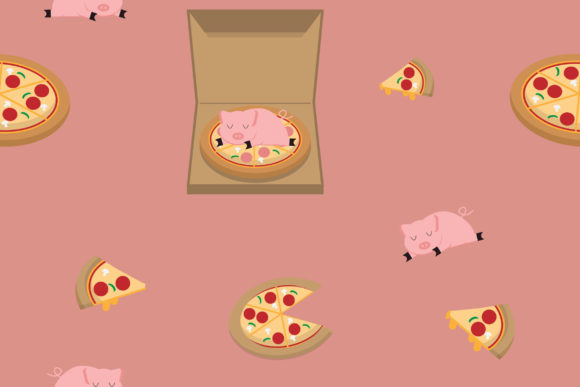
“Pig on the Pizza” isn’t just a whimsical phrase—it’s a charming, hand-drawn cartoon motif that’s become a quiet favorite among surface pattern designers, crafters, and small-batch product creators. At its core, it features a cheerful pig snoozing peacefully atop a slice of pizza—think soft curves, expressive eyes, and gentle humor. When repeated in a seamless tile, it transforms into a versatile fabric or wallpaper pattern ideal for baby clothes, kitchen textiles, greeting cards, tote bags, and even playful web backgrounds.
What makes this design stand out isn’t just its cuteness—it’s the thoughtful execution behind the seamless repeat. A well-built pattern ensures no visible seams, consistent spacing, balanced visual weight, and scalability across sizes. But here’s where many people run into trouble—not because the idea is complicated, but because assumptions about “cute” or “cartoon” patterns often skip over technical essentials.
Common Missteps—and Why They Matter
Mistake #1: Assuming “cute” means “simple to adapt.” Some users download the Pig on the Pizza pattern expecting instant drag-and-drop use—only to find alignment issues when scaling for yardage or printing on stretch fabric. The problem? Not all seamless repeats behave the same way across substrates. A 1:1 ratio (square tile) works beautifully for digital mockups and screen printing, but if your printer requires bleed or your fabric has directional stretch, ignoring tile boundaries can lead to awkward cropping or distorted pigs mid-slice.
Mistake #2: Overlooking file format limitations before purchase or download. You’ll often see listings offering “AI, EPS, JPG”—but those aren’t interchangeable. An AI file (Adobe Illustrator) preserves vector paths and layers—ideal for resizing without quality loss or editing individual elements like the pig’s blush or cheese strings. EPS is older but still widely supported for print workflows. A JPG? It’s raster-only, fixed-resolution, and not editable. If you plan to recolor, isolate the pig, or adjust spacing, relying solely on the JPG version will limit what you can do—and may force costly redesigns later.
Mistake #3: Skipping color mode and resolution checks. Even with perfect files, mismatched settings sabotage results. Printing a CMYK-optimized pattern on an RGB-based POD (print-on-demand) platform can mute reds in the tomato sauce or dull the pig’s pink. Likewise, a 72 PPI JPG won’t hold up on a 54″ wide fabric roll—even if the tile itself is seamless. Always verify whether your end use calls for RGB (digital screens), CMYK (professional textile printing), or sRGB (most POD services).
What to Check Before You Use or Buy
Before downloading or licensing Pig on the Pizza—or any cartoon seamless pattern—take three minutes to confirm these practical details:
- Tile integrity: Open the file and duplicate the tile four times in a grid (2×2). Zoom in at 200%. Look for subtle misalignments along edges—especially around the pig’s snout or pizza crust. True seamlessness means zero ghost lines or doubled outlines.
- Editable layers: In the AI file, check the Layers panel. Are pig, pizza, background, and shadow on separate layers? Can you toggle visibility or change colors individually? If everything’s merged into one shape, editing flexibility drops significantly.
- Scale reference: Does the listing include a real-world size guide? For example: “At 100% scale, the pig measures 2.3 cm tall.” This helps estimate how large the motif appears on a finished pillowcase or apron—avoiding surprises like a 6-inch pig dominating a child’s bib.
Better Choices for Real Projects
Let’s say you’re designing organic cotton napkins for a local café. You love Pig on the Pizza—but want to ensure warmth and cohesion. Instead of applying the full pattern at maximum scale, try reducing the tile to 60% and layering it subtly beneath a tone-on-tone tomato-red stripe. That keeps the charm while grounding it in context.
Or imagine you’re a freelance illustrator building a portfolio site. Using the EPS version as a CSS background image (with background-size: 200px) gives crisp rendering on retina displays—while the AI file stays ready for client revisions. No need to trace or redraw; just adjust spacing or export new swatches.
For educators or hobbyists teaching pattern design, Pig on the Pizza serves as an excellent case study in balance: the pig’s roundness offsets the pizza’s angular slice; warm tones contrast without clashing; and the sleeping pose adds quiet rhythm. It’s not chaotic cuteness—it’s intentional composition.
Why File Variety Isn’t Just Marketing Fluff
The inclusion of AI, EPS, and JPG files isn’t about padding a product page—it reflects real-world workflow diversity. Here’s how each fits:
- AI file: Your creative control center. Resize infinitely, convert strokes to outlines, add Pantone swatches, or extract the pig alone for a sticker sheet.
- EPS file: Your print-safe fallback. Most textile mills accept EPS without font or effect dependencies—ideal when submitting to overseas manufacturers.
- JPG file: Your quick-preview tool. Perfect for mood boards, social media tiles, or client PDFs where editability isn’t needed—but never your sole source for production.
Using only the JPG because it’s “easiest” is like using a screwdriver to hammer a nail: it might sort-of work once, but it slows you down, risks damage, and limits what comes next.
A Final Note on Intentionality
Cute patterns like Pig on the Pizza succeed not because they’re harmless or decorative, but because they carry tone, timing, and texture. A sleeping pig on pizza suggests comfort, playfulness, and gentle absurdity—qualities that resonate with audiences from Etsy shoppers to boutique hotel designers. But resonance depends on execution. A poorly spaced repeat feels restless. A muddy color conversion drains joy. A non-scalable file forces compromise.
So when you choose Pig on the Pizza—or any seamless cartoon fabric pattern—ask not just “Does it look fun?” but “Does it support what I actually need to build?” That shift in focus turns a charming download into a reliable, adaptable, professional-grade asset.